Let's go over some basics:
Single Action (SA) / Double Action (DA)
A single Action pistol will only fire after you have cocked the hammer. In a revolver, you cock the hammer with whichever hand is not your trigger-hand (so that you don't shift your grip to do so). With a pistol, racking the slide (pulling it back and letting it snap forwards again) will load a round into the chamber ready for firing and will also, in the same movement, cock the hammer. In a SA pistol, you can also cock the hammer with your non-trigger hand like a revolver. With a SA pistol, you must do one of these two actions or nothing will happen when you pull the trigger. SA triggers are typically very light. A DA revolver or pistol has a longer and harder trigger pull. The first part of the trigger pull will cock the hammer if it isn't already cocked and then - when the pull continues, will drop the hammer, firing the round. A single Action only pistol is called a "SA" or "SAO" pistol. A double action only "DAO" (often small concealable pistols are DAO, but I also count the Glock series as DAO pistols, which many Glock fans disagree with. Oh well...). Pistols which can be worked both ways are sometimes called "SA/DA" pistols. With a pistol sich as the SIG or the CZ 75B, once the first shot has been fired in SA or DA, the remaining shots in the magazine are fired as SA shots. Glocks are DA with every shot. Revolvers which can work both ways always drop back into DA and need to be re-cocked by hand between each shot if you want to shoot SA. This is because they don't have a slide which slides backwards with the recoil of each shot, recocking the hammer and ejecting the spent round and reloading the next one (this is why these latter pistols are also called "semi-automatic" or "autoloading", incidentally).
Rimfire / Centerfire
Rimfire ammunition is fired by a hammer or firing pin striking the edge of the cartridge. Centerfire ammunition - logically - is fired by a hammer of firing pin striking the center of the cartridge. Nowadays, "rimfire" has become almost synonymous with .22 weapons. .22 gauge (including the very popular .22lr round) are rimfire. 9mm, .38 .357 and other Magnum rounds are centerfire. This has few implications in the actual handling of the gun in question - with one very important exception. This is very important: You should never dry-fire a rimfire gun. Dry-firing means letting the hammer click onto an empty chamber. The problem here is that the firing pin will shoot forward, expecting to meet the edge of a cartridge to impact. Finding nothing, it may shoot on forwards, hard, and be stopped by the edge of the chamber. This won't break the pistol or rifle if it happens a few times, but eventually it will damage the chamber, the firing pin or both. The firing pin on centerfire pistols, if they are dry-fired, will shoot forwards into an empty chaber, encounter nothing, and eventually be stopped by their own mechanism. So they don't hammer against any part of the chamber. There is less potential for damage here.
In any case, it's better to be safe than have damaged pistol, so buy a handful of cheap "snap caps" for dry firing. Snap caps are dummy rounds which don't fire (and are usually bright red to distinguish them from the "real thing"). A rimfire pistol can be safely fired onto a snap cap. A centerfire pistol, obviously, too. By the way, ALWAYS store snap caps and live ammunition separately! You don't want to accidentally load a live round, thinking it's a snap cap, do you?
The parts of a pistol
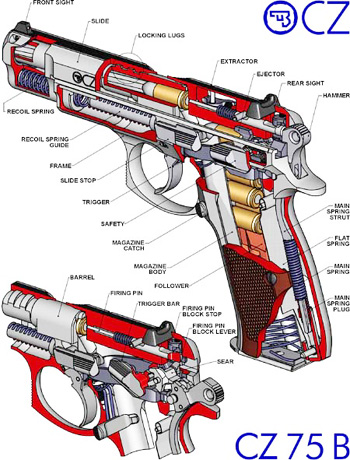
Knowing what's what on a pistol helps follow instructions on use and conduct a competent discussion (or even ask the right questions) on a range. Without going into too much detail, here is a general overview:
The slide slides backwards (that's why it's called a "slide", get it?) and absorbs some of the recoil when a shot is fired, ejecting the spent round, recocking the hammer and reloading a fresh one from the magazine as it goes. The barrel is generally covered by the slide and is simply the tube the bullet shoots along when fired. The firing pin is like a nail struck by the hammer at one end which hits the back of the round in the chamber at the other, igniting the primer which set off the round. Notice the magazine catch (or magazine release button) close to where the trigger guard meets the handle. The trigger is where you finger should NOT go until you are ready to fire. The safety, when engaged, blocks the pistol's mechanism so that it can't be fired. You need to disengage it in order to fire. The extractor grabs the end of the spent cartridge as the slide slides backwards and the ejector kicks the spent round out in an arc to the right of the pistol (so that is a bad place to stand if you're just watching - spent rounds are hot!).
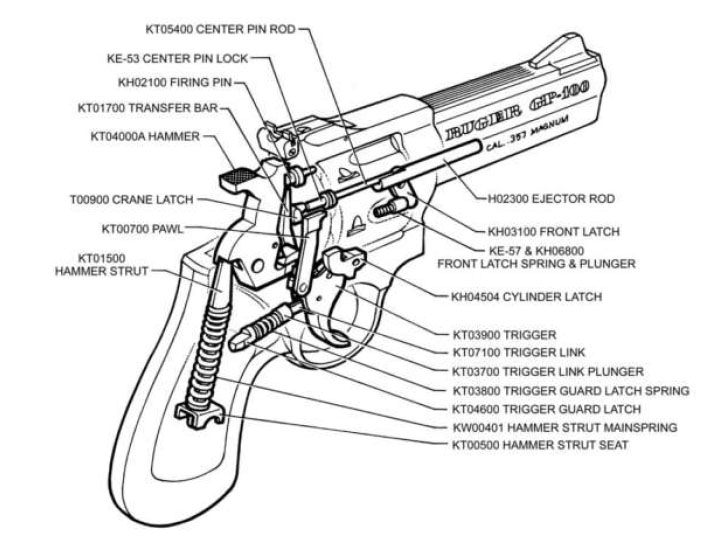
Instead of a magazine, they have a rotating cylinder containing six rounds (today revolvers can hold more or less than six, but six is most common). A cylinder is lined up with the barrel and effectively becomes an extension of the barrel. The round is fired by the hammer and firing pin, and then the process or re-cocking the hammer (either in DA or by pulling back the hammer by hand) aligns the next cylinder with the barrel. spent rounds are not ejected from a revolver.
Instead, they have to be removed by hand once all cylinders have been fired. Usually you eject them by swinging the cylinder out to the left and then pressing the ejector rod at the front of the cylinder, which then allows you to tip the spent rounds out.
Revolvers have a reputation for greater ruggedness than auto-loading pistols. This is not surprising given the smaller number of moving parts and the greater overall simplicity of the design. This is one reason why the larger calibers (Magnum, etc.) more powerful rounds are generally designed for and fired from revolvers.
Revolvers (DA or SA/DA ones, anyway) are also popular because they are easy to fire. Just pick one up, point it and pull the trigger. Whether an untrained shooter will actually hit anything is another question, but a shot will go off if the revolver is loaded. With an auto-loader, inserting a magazine into the pistol isn't enough to prepare it for firing. A round has to be chambered (by pulling back the slide and letting it snap forwards. Also, the safety has to be off or nothing will happen. If you hold an auto-loader wrong (with your supporting hand too high up behind the hammer), the slide will injure the shooter's hand. Ouch. I know. Don't ask. If you're not particularly intelligent and hold onto a revolver by wrapping your hand around the front of a cylinder (which is a really stupid and pointless way to hold a pistol anyway), then you will burn your hand when the shot goes off, as hot gases shoot out sideways through the gap between the front of the cylinder and back of the barrel. I saw a guy do this at the range. Not a bad injury, but painful. Oh yeah - and embarassing.
Disclaimer: All information on this page is the result of the author's personal experience and his personal opinion. He does not consider himself an expert on the subject, merely an interested person. If the information here is wrong, then please let him know. If you disagree, then you're most welcome to discuss in a civilised manner. If you are not prepared to discuss differences of opinion in a civilised manner, then get lost.